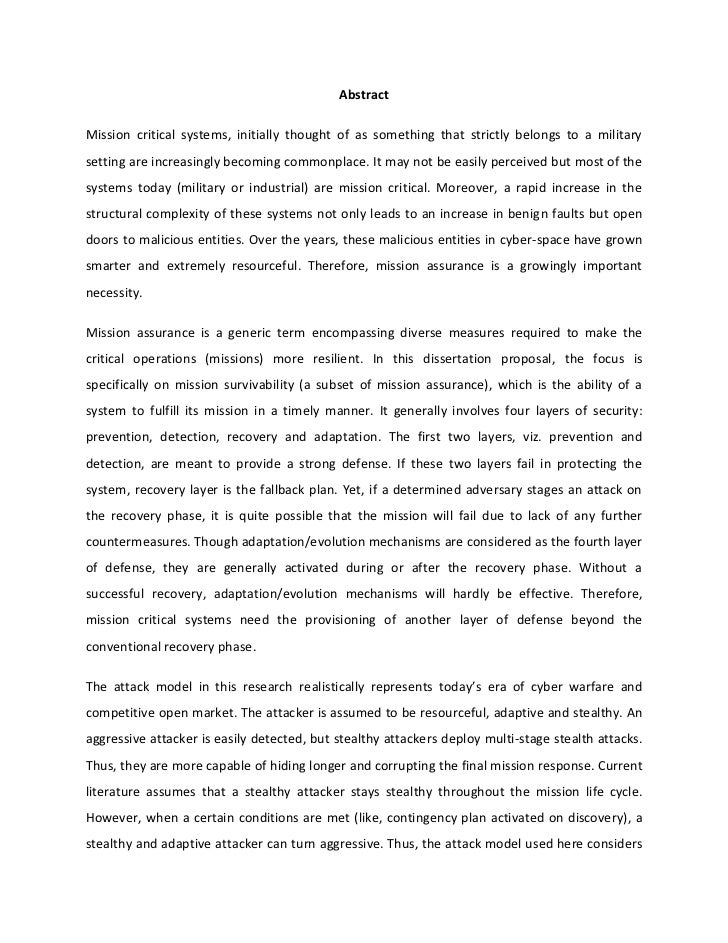
Abstract: “My dissertation argues that fiction produced in England during the frequent financial crises and political volatility experienced between and both reflected and shaped the cultural anxiety occasioned by a seemingly random and increasingly uncertain world In brief, an abstract should: Intrigue – In the first few sentences, you should introduce your topic to the reader, and highlight a key debate or Convince – You’ll then need to convince your reader that your dissertation is necessary and worthwhile. Often, this is Describe – You should Every proposal should have an abstract. The abstract forms the reader’s initial impression of the work, and therefore plays a big role on whether the application is funded. The abstract speaks for the proposal when it is separated from it, provides the reader with his or her first impression of the request, and, by acting as a summary, frequently provides the reader their last impression
How to Write an Abstract for a Proposal | Pen and the Pad
My dissertation addresses the question of how meaning is made when texts and images are united in multimodal arguments.
Visual rhetoricians have often attempted to understand text-image arguments by privileging one medium over the other, either using text-based rhetorical principles or developing new image-based theories. In each of these periods, I argue that dissociation reveals how the privileged medium can shape an entire multimodal argument. I conclude with a discussion of abstract in a dissertation proposal multimodal pedagogy, applying dissociation to the multimodal composition classroom.
I argue that the space of the specter is a force of representation, an invisible site in which the uncertainties of antebellum economic and social change become visible. Methodologically, Apparitional Economies moves through historical events and textual representation in two ways: chronologically with an attention to archival materials through the antebellum era beginning with the specters that emerge with the Panic of and interpretively across the readings of a literary specter as a space of lack and potential, as exchange, as transformation, and as the presence of absence.
As a failed body and, therefore, a flawed embodiment of economic existence, the literary specter proves a powerful representation of antebellum social and financial uncertainties.
Michael Todd Hendricks Drawing from the history of adolescence and the context of midcentury female juvenile delinquency, I argue that studios and teen girl stars struggled for decades with publicity, censorship, and social expectations regarding the sexual license of teenage girls. Until the late s, exploitation films and B movies exploited teen sex and abstract in a dissertation proposal while mainstream Hollywood ignored those issues, struggling to promote teen girl stars by tightly controlling their private lives but depriving fan magazines of the gossip and scandals that normally fueled the machinery of stardom.
This new image was a significant departure from the widespread belief that the sexually active teen girl was a fundamentally delinquent threat to the nuclear family, and offered a liberal counterpoint to more conservative teen girl prototypes like Hayley Mills, which continued to have cultural currency. It explores the literary presence of the middle class managing daughter in the Victorian home. Collectively, the novels in this study articulate social anxieties about the unclear and unstable role of daughters in the family, the physically and emotionally challenging work they, and all women, do, and the struggle for daughters to find a place in a family hierarchy, which is often structured not by effort or affection, but by proscribed traditional roles, which abstract in a dissertation proposal not easily adapt to managing daughters, even if they are the ones holding the family together.
The managing daughter is a problem not accounted for in any conventional domestic structure or ideology so there is no role, no clear set of responsibilities and no boundaries that could, and arguably should, abstract in a dissertation proposal, define her obligations, offer her opportunities for empowerment, or set necessary limits on the broad cultural mandate she has to abstract in a dissertation proposal and care others.
The extremes she is often pushed to reveals the stresses and hidden conflicts for authority and autonomy inherent in domestic labor without the iconic angel in the house rhetoric that so often masks the difficulties of domestic life for women.
She gains no authority or stability no matter how loving or even how necessary she is to a family because there simply is no position in the parental family structure for her. The managing daughter thus reveals a deep crack in the structure of the traditional Victorian family by showing that it often cannot accommodate, protect, or validate a loving non-traditional family member because it values traditional hierarchies over emotion or effort.
Yet, abstract in a dissertation proposal, in doing so, it also suggests that if it is position not passion that matters, then as long as a woman assumes the right position in the family then deep emotional connections to others are not necessary for her to care competently for others. Virginia B. Engholm The average birth rate per woman in was just over seven, but bythat rate had fallen to just under than three and a half.
The question that this dissertation explores is what cultural narratives about reproduction and reproductive control emerge in the wake of this demographic shift. How do women, and society, control birth? This dissertation, then, constructs a cultural narrative of the process of controlling birth.
While the chapters of this work often focus on traditional sites of birth control—contraceptives, abortion, and eugenics—they are not limited to those forms, uncovering previously hidden narratives of reproduction control.
By focusing on a variety of cultural texts—advertisements, fictional novels, historical writings, medical texts, popular print, and film—this project aims to create a sense of how these cultural productions work together to construct narratives about sexuality, reproduction, and reproductive control. Relying heavily on a historicizing of these issues, my project shows how these texts—both fictional abstract in a dissertation proposal nonfictional—create a rich and valid site from which to explore the development of narratives of sexuality and reproductive practices, as well as how these narratives connect to larger cultural narratives of race, class, and nation, abstract in a dissertation proposal.
The interdisciplinary nature of this inquiry abstract in a dissertation proposal the interrelationship between the literary productions of the nineteenth and twentieth century and American cultural history.
Amber M. Stamper Most recently, these Christian evangelists have gone online. As a contribution to scholarship in religious rhetoric and media studies, this dissertation offers evangelistic websites as a case study into the ways persuasion is carried out on the Internet. Through an analysis of digital texts—including several evangelical home pages, a chat room, abstract in a dissertation proposal, discussion forums, and a virtual church—I investigate how conversion is encouraged via web design and virtual community as well abstract in a dissertation proposal how the Internet medium impacts the theology and rhetorical strategies of web evangelists.
The project begins within the historical framework of the multiple financial crises that occurred in the late abstract in a dissertation proposal century: seven crises took place between and alone, appearing seemingly out of nowhere and creating a climate of financial meltdown.
But how did the awareness of economic turbulence filter into the creative consciousness? Through an interdisciplinary focus on cultural studies and behavioral economics, the dissertation posits that in spite of their conventional, status quo affirming endings opportunists are punished, lovers are marriednovels and plays written between and contemplated models of behavior that were newly opportunistic, echoing the reluctant realization that irrationality had abstract in a dissertation proposal the norm rather than a rare aberration.
By analyzing concrete narrative strategies used by writers such as Frances Burney, Georgiana Cavendish, abstract in a dissertation proposal, Hannah Cowley, and Thomas Holcroft, I demonstrate that late eighteenth-century fiction both articulates and elides the awareness of randomness and uncertainty in its depiction of plot, character, and narrative, abstract in a dissertation proposal.
George Micajah Phillips In response, Oscar Wilde, Joseph Conrad, abstract in a dissertation proposal, T. Eliot, and others sought to better understand how identity was recognized, particularly visually.
By exploring how painting, photography, colonial exhibitions, and cinema sought to manage visual representations of identity, these modernists found that recognition began by acknowledging the familiar but also went further to acknowledge what was strange and new as well, abstract in a dissertation proposal. Aparajita Sengupta Indian cinema is a subject about which conceptions are still muddy, even within prominent academic circles.
The majority of the recent critical work on the subject endeavors to correct misconceptions, analyze cinematic norms and lay down the theoretical foundations for Indian cinema. This dissertation conducts a study of the cinema from India with a view to examine the extent to which such cinema represents an anti-colonial vision.
The political resistance of Indian films to colonial and neo-colonial norms, and abstract in a dissertation proposal capacity to formulate a national identity is the primary focus of the current study. Kenneth Carr Hawley For Boethius, confused and conflicting views on fame, fortune, happiness, good and evil, fate, free will, necessity, foreknowledge, and providence are only capable of clarity and resolution to the degree that one attains to knowledge of the divine mind and especially to knowledge like that of the divine mind, which alone possesses a perfectly eternal perspective.
Thus, as it draws upon such fundamentally Boethian passages on the eternal Prime Mover, this study demonstrates how the translators have negotiated linguistic, literary, cultural, religious, and political expectations and forces as they have presented their own particular versions of the Boethian vision of eternity.
Even though the text has been understood, accepted, and appropriated in such divergent ways over the abstract in a dissertation proposal, the Boethian vision of eternity has held his Consolations arguments together and undergirded all of its most pivotal positions, without disturbing or compromising the philosophical, secular, academic, or religious approaches to the work, as readers from across the ideological, theological, doctrinal, and political spectra have appreciated and endorsed the nature and the implications of divine eternity.
It is the consolation of eternity that has been cast so consistently and so faithfully into Old, Middle, and Early Modern English, regardless of form and irrespective of situation or background. For whether in prose and verse, all-prose, abstract in a dissertation proposal all-verse, and whether by a Catholic, a Protestant, a king, a queen, an author, or a scholar, each translation has presented the texts central narrative: as Boethius the character is educated by the figure of Lady Philosophy, his eyes are turned away from the earth and into the heavens, moving him and his mind from confusion to clarity, from forgetfulness to remembrance, from reason to intelligence, and thus from time to eternity.
Douglas Larue Reside The form remains, however, virtually unstudied by literary scholars. In part, this may be a result of the difficulty of accessing abstract in a dissertation proposal texts. Reading a musical from a traditional codex is no easy matter.
The integration of text and music in a musical make it inappropriate to separate the two. One can try to follow along with a cast recording. In most cases, though, this is awkward. Many cast albums record a significantly modified version of the score and lyrics and few include the entire work. Further, musical theatre texts often exist in many different versions. This work begins with a summary of the problems one encounters when editing a multi-authored text musicals often have a lyricist, librettist, and composer which may be revised for practical rather than aesthetic reasons.
The merits of restoring the material changed during the production process are debated. In this discussion some attempt is made to abstract in a dissertation proposal who should be considered the dominating collaborator or auteur of a musical. Ultimately, this dissertation argues that the notion of trying to restore an "authorial Ur-Text" makes little sense given the multitude of collaborators involved in the process of making musicals. Instead, an electronic variorum edition is presented as an alternative means of studying and teaching musical theatre texts.
The study concludes with a narrative of the authors own work on an electronic edition of the Broadway musical Parade and ends with a critical introduction to this text. Skip to main content. People Map. English Graduate Program Master of Arts in English Master of Fine Arts in Creative Writing Doctor of Philosophy in English PhD Admissions PhD Timeline PhD Funding PhD News Sample Dissertation Abstracts Graduate Student Handbook Graduate Student Success Stories English Graduate Student Organization Preparing Future Faculty Graduate Courses Request More Information.
Share this page:. Amy K. Working Group Graduate Courses Request More Information. If you have questions about any aspect of the English Department, course registration, enrollment, and general information, please contact the Chair, Jonathan Allison, at jonathan. allison uky. edu or phone If you have questions about the Undergraduate Program please contact our Director of Undergraduate Studies, Michelle Sizemore, michelle.
sizemore uky. edu If you have questions about the Graduate Program MA and PhD please contact our Director of Graduate Studies, Michael Trask, abstract in a dissertation proposal, at michael. trask uky. edu If you have questions about the MFA Program please contact our Director of Creative Writing, Frank X Walker, at fxw2 uky.
edu If you have general department questions please contact Kristen Pickett, kristen. pickett uky. eduor Robin Rahija, robin. rahija uky. edu Department of English Patterson Office Tower Lexington KY This login is SSL protected. Request new password.
Writing Tips for PhDs! How to: Proposal, Abstract, Lit Review, Research Article, Figures \u0026 Thesis
, time: 52:51How to Write an Abstract for a Dissertation
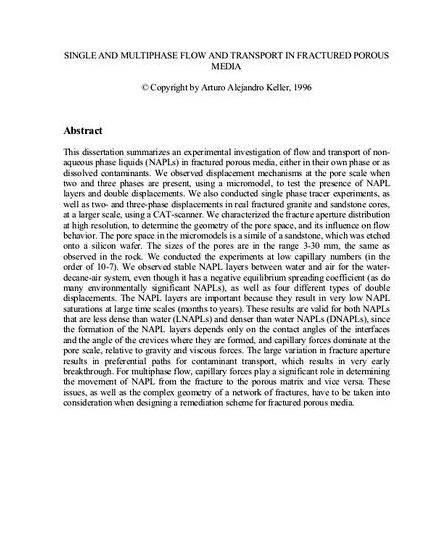
In brief, an abstract should: Intrigue – In the first few sentences, you should introduce your topic to the reader, and highlight a key debate or Convince – You’ll then need to convince your reader that your dissertation is necessary and worthwhile. Often, this is Describe – You should Every proposal should have an abstract. The abstract forms the reader’s initial impression of the work, and therefore plays a big role on whether the application is funded. The abstract speaks for the proposal when it is separated from it, provides the reader with his or her first impression of the request, and, by acting as a summary, frequently provides the reader their last impression Abstract: “My dissertation argues that fiction produced in England during the frequent financial crises and political volatility experienced between and both reflected and shaped the cultural anxiety occasioned by a seemingly random and increasingly uncertain world

No comments:
Post a Comment